When you hire a conference centre or a hotel ballroom, it is tempting to assume the venue has safety covered. It has a fire certificate, trained staff and an evacuation plan. Much of that is true, and the venue does carry real legal duties. But the Health and Safety Executive (HSE) is clear that the organiser has duties too, and they do not pass to the venue because you have paid for the room.
This piece sets out who is responsible for what when you run an event in a hired venue in Great Britain, and how to divide the work so that nothing falls between you.
The organiser’s duty
HSE’s guidance for event organisers, Managing an event, says the organiser is responsible for ensuring that overall safety at the event is maintained so that, as far as reasonably practicable, people setting up, breaking down and attending the event are not exposed to risks to their health and safety. HSE lists what this includes:
- having health and safety arrangements in place to control risks;
- ensuring co-operation and co-ordination of work activities;
- giving employees and others relevant information about risks;
- ensuring staff are competent to do their role safely;
- monitoring compliance and reviewing the arrangements.
These duties come from the Health and Safety at Work etc. Act 1974, which requires employers to protect their employees (section 2) and to ensure that people who are not their employees, such as delegates, contractors and the public, are not exposed to risks from how they conduct their undertaking (section 3). The Management of Health and Safety at Work Regulations 1999 add the duty to carry out a suitable and sufficient risk assessment and, where employers share a workplace, to co-operate and co-ordinate with each other.
HSE’s guidance on getting started makes the point that planning should be proportionate to the scale of the event and the degree of risk. A 40-person seminar in a hotel meeting room needs a short risk assessment. A 1,500-person conference with a stage build, exhibition and evening party needs considerably more.
The venue’s duties
The venue operator has its own duties as an employer and as the party in control of the premises. In England and Wales, the Regulatory Reform (Fire Safety) Order 2005 places fire safety duties on the “responsible person” for the premises, normally the person or organisation in control of them. Scotland and Northern Ireland have their own fire safety legislation. The venue will usually be responsible for the building’s fire risk assessment, fire alarm and detection, means of escape, and its own staff.
Your event can change the risks the venue has assessed: a stage across a fire exit, a dark room with haze, more people than the room’s usual layout, temporary power, or catering in an unusual space. That is why the venue will want your plans in advance, and why you need to know its fire strategy and evacuation procedures before you finalise your layout.
Contractors and suppliers
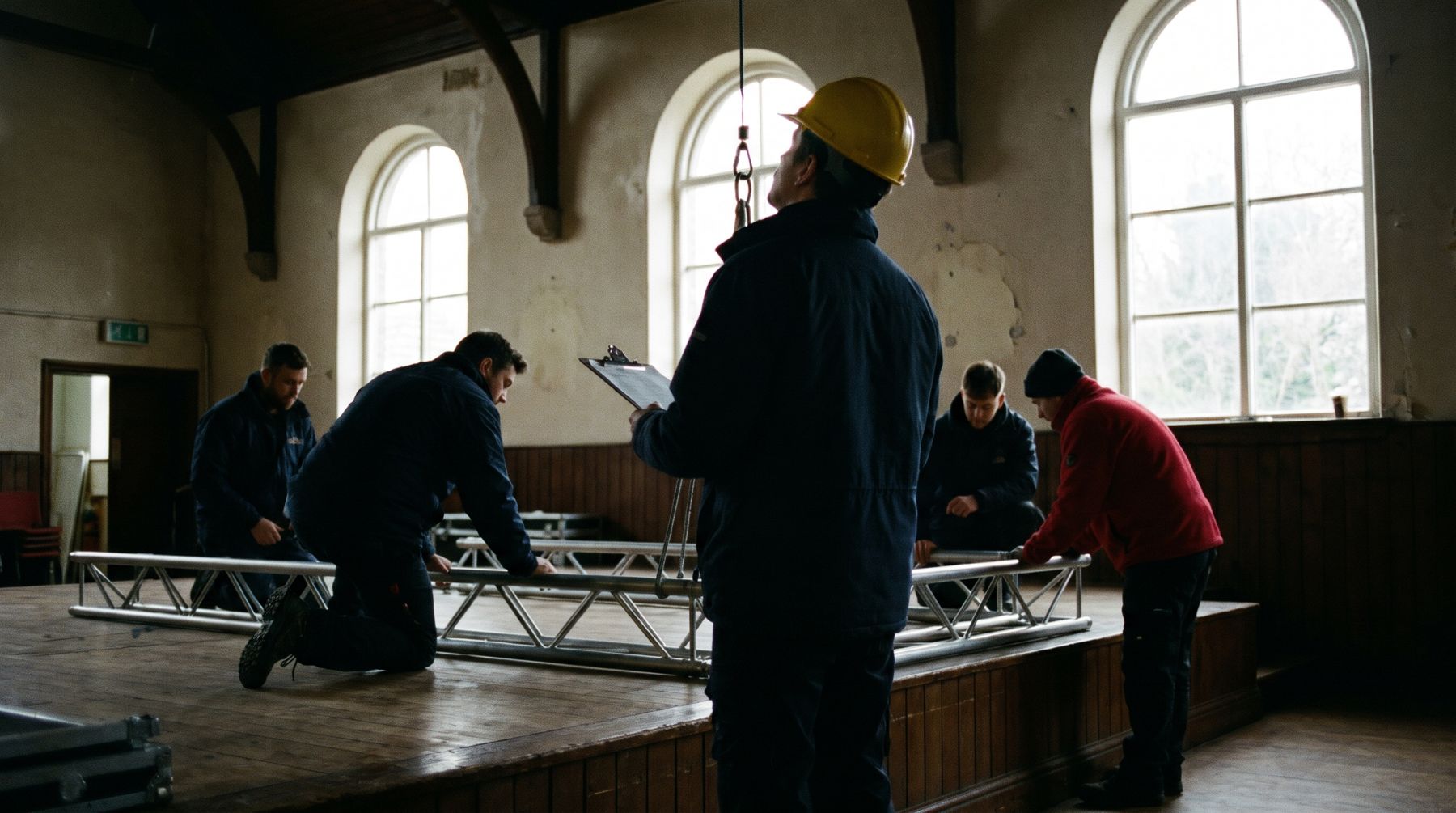
AV, staging, production, catering and exhibition contractors each have their own duties for their own work. HSE’s guidance says that ensuring co-ordination does not make the organiser responsible for all the technical work done by third parties. Instead, you should develop a safe overall programme of work, taking into account the contractors’ risk assessments, and communicate it to everyone involved.
When appointing contractors, HSE suggests asking them to show knowledge of their work and its hazards, evidence of a trained workforce and competent key staff, sufficient resources, and previous work that shows they can work safely. Where an event involves building temporary structures such as stages, HSE points organisers to its guidance on the Construction (Design and Management) Regulations 2015.
Build-up and breakdown deserve as much attention as the event itself. HSE notes that although there are fewer people on site during load-in and load-out, these are likely to be the times when the highest-risk work happens.
Emergencies
HSE’s guidance on planning for incidents and emergencies expects organisers to have plans proportionate to the risk. In a fixed venue with established procedures, your emergency plan will largely be the venue’s, but you still need to know:
- how the alarm is raised and how your attendees will be told what to do;
- where people go, and how you account for them;
- how disabled attendees will be evacuated, and who will help;
- who calls the emergency services, and who meets them;
- who has the authority to stop the show, and how that is done;
- first aid provision, including for attendees, not only staff.
Once Martyn’s Law is in force, which the SIA expects in spring 2027, many venues will also have formal procedures for evacuation, invacuation, lockdown and communication in the event of a terrorist attack. Your team should be briefed on them.
Larger and outdoor events
For larger outdoor events, the standard industry reference is the Purple Guide, originally published by HSE and published by the Events Industry Forum since 2012. It is subscription-based. Local authorities often convene a Safety Advisory Group for larger public events, to which organisers present their plans. HSE’s event safety pages remain the starting point for smaller events.
Dividing the work
The simplest way to avoid gaps is to write down who does what. For a conference in a hired venue, a one-page responsibilities table agreed with the venue and your main contractors might cover:
| Area | Usually led by | Organiser’s role |
|---|---|---|
| Building fire risk assessment and alarm | Venue | Share layout and plans; check they do not affect escape routes |
| Event risk assessment | Organiser | Write it, including activities, layout, crowd flow and evening programme |
| Stage, rigging and AV | Contractor | Collect risk assessments and method statements; fit them into the build schedule |
| Catering and food safety | Venue or caterer | Pass on dietary and allergy information accurately and in time |
| Evacuation | Venue | Brief your team; plan assisted evacuation for those who need it |
| First aid | Venue, organiser or both | Agree cover for the numbers and activities, in writing |
| On-the-day monitoring | Organiser | Name who checks, how often, and who can change plans |
Agree it before contracts are signed where you can. It is much harder to negotiate on the week of the event.
How Tallis Row helps
Through event risk, safety and duty of care, we write event risk assessments and safety plans, check contractor competence, and agree the responsibilities table with your venue. On events we deliver through conference and event management, this work is built in from the start.
Last reviewed November 2026. General information, not legal or tax advice.